One thing is for sure, the HR tech market isn’t short of competition.
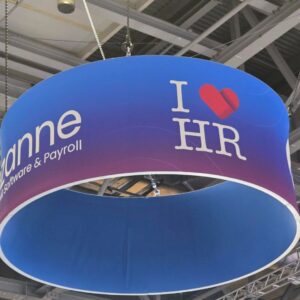
At this year’s HR Technologies event, the global giants were out in full force commanding attention by name alone and attracting visitors with their innovative stands. From Piña Colada flavoured ice cream through to personalised AI image cards you could print and take back to the office (yes, I now have a version of myself as an astronaut sitting next to my desktop). Yet, once you got past the theatre of it all, one thing became clear: most brands were promoting similar messages.
‘We’re an all-in-one platform’
‘We’re AI powered’
‘We support the entire employee lifecycle’
If you strip it back, it all adds up to the same promise; to make HR’s life easier. And, let’s face it, it’s a role that needs it. From implementing policies and managing difficult conversations to juggling sick leave, holidays, and everything in between, HR is a complex, high-pressure function. But in a market where everyone is saying the same thing, what actually makes a HR tech brand stand out?

Being well known is not enough anymore
For the biggest names in the HR world, recognition isn’t an issue. They’re already established. Already trusted. And already part of the conversation. But that brings a different challenge. This isn’t a market where people are trying to work out who you are. It’s a market where they’re trying to decide why you’re the better choice. Brand recall and visibility become less important. Instead, the focus shifts to giving audiences a compelling reason to choose you over the competition. What actually makes you different? Why does that matter? And why should they care now? These questions can often get lost, especially when every brand is leading with the same claims meaning even the strongest brands begin to feel interchangeable.
This is where HR tech marketing needs to roll up its sleeves by moving beyond awareness and focusing on relevance.
When messaging moves ahead of understanding
One of the most interesting takeaways from conversations on the day was this: while the messaging has moved quickly, understanding hasn’t always kept up.
A lot of people I spoke to openly said the same thing. HR isn’t a tech-first function. It’s people-first. So the way technology is introduced, explained and actually brought to life really matters. There’s definitely interest. Even a sense of curiosity around what’s possible. But that doesn’t always translate into confidence. And when that confidence isn’t there, adoption naturally slows because they’re not always being explained in a way that feels clear or grounded in how HR teams actually work. That’s where the gap starts to show. Between what brands are saying, and what their audience is actually taking in.
Among all the noise, a few brands stood out. Not for the biggest claims or the most advanced features, but simply because they did things differently. Some leaned into humour. Others focused more on culture and people. And a few created something you actually wanted to stop and engage with (who doesn’t want to hear about the juiciest HR moments happening in companies that aren’t yours – nice work, Rippling). None of it was overly complicated. But it worked. It made it easier to picture how what they offer fits into everyday working life, and that kind of clarity really makes a difference.

AI is everywhere, but meaning is not
AI dominated almost every conversation, every stand and every piece of messaging. But when everyone is talking about it, it very quickly stops being a differentiator. It just becomes expected. What’s often missing is the explanation. What does it actually mean for a HR team in practice? Where does it save time, where does it add value, and where does it still need human input? And, more importantly, what does it enable HR to do for their people?
This is something HR Consultant, Stephen Cloves, touched on in our recent conversation. The focus should not be on what the technology does for HR, rather how it helps HR do more for the people they are responsible for. That shift might sound subtle. It is significant. HR is not measured by the tools it uses. It is measured by the impact it has on engagement, culture and wellbeing. If the technology is not clearly linked back to that, it risks feeling distant. Functional. Just another system to learn, rather than something that genuinely makes a difference. These are the things that build trust. Without them, even the most advanced capabilities can feel vague. If people do not fully understand something or see how it connects to what actually matters in their role, they are unlikely to rely on it.
From being seen to being understood
For a long time, the focus in B2B marketing has been on visibility. Getting in front of the right audience, building recognition and staying top of mind. And that still matters. But in a category like HR tech, where many of the major players are already well known, it is no longer the thing that moves the needle.
What matters now is understanding. Helping someone move from “I’ve heard of them” to “I understand what they do and why it matters to me”. That shift is where decisions are made. Because when someone understands how something fits into their day-to-day role, it stops being a nice to have. It becomes something they can actually use. And that changes the conversation entirely.
There is no shortage of innovation in HR tech. But there is a shortage of brands making that innovation easy to grasp. The ones that stand out are not the ones with the biggest claims or the loudest messaging. They are the ones that take the time to explain. The ones that connect what they do to the realities their audience is dealing with every day.
Because when HR professionals are faced with yet another platform, another promise, another new way of working, they are not just asking what it is. They are asking whether it will genuinely help them do their job better and support their people more effectively.
When brands can answer that clearly, they do more than just get noticed. They get chosen.
How we can help make your HR tech brand relevant
If this sounds familiar, you’re not alone. Many HR tech brands are facing the same challenge. The opportunity isn’t to say more, it’s to say it in a way that actually lands.
At Skout, we work with brands to turn complex propositions into clear, credible stories that resonate with the right audiences. Find out about our approach here: https://skoutpr.com/approach/