

As a B2B marketing leader, you’ve likely seen competitors steal the spotlight while your industry-leading services and solutions remain invisible. Despite deeper expertise and better results, your content just isn’t cutting through. You’ve tried different tactics, but nothing sticks; it’s causing lots of headaches for you and your team. Our latest blog explores why it’s time to tap into the insights of your spokespeople and make thought leadership your strongest marketing advantage.
B2B thought leadership is no longer a ‘nice to have’ in today’s AI-driven world; search engines and enterprise discovery tools now prioritise depth of expertise over promotional messaging. Google’s ranking systems, for example, focus on E-E-A-T (Experience, Expertise, Authoritativeness and Trustworthiness). And AI search tools such as Perplexity or ChatGPT are following a similar trend, favouring expert-led blog posts, definitive guides, FAQs and data backed studies. This means content that demonstrates real knowledge and value is more likely to rank well.
However, it’s not just discovery tools favouring thought leadership. When it comes to creating meaningful and trusted connections with audiences through channels such as trade publications, websites and even social media, B2B professionals want to learn from human-driven insights rather than consume material that is clearly AI-generated. (Consider the types of content that engages you the most – is it likely from a human brain or an AI?).
There have been countless studies to support this and academic research has found that when people know content is created by a human they show a positive bias towards it even if the AI-generated content is equally as persuasive. Just to reinforce the point, here are some other research examples that nod to the value of human-led thought leadership:
- A comparative analysis of AI vs human writers in B2B marketing found that human written content often performs better as it can address specific pain points, build trust, and guide prospects through the buyer journey with tailored messaging.
- Forbes Agency Council highlights that business audiences expect originality and insight, which human writers are better equipped to deliver. While AI can assist with volume and efficiency, shallow or parroted content risks damaging brand reputation in B2B contexts.
So let’s bring it back to the original point; the companies winning your target accounts aren’t necessarily the biggest or loudest, they’re the ones positioning their internal experts as trusted industry voices.
As a marketing leader juggling competing priorities and tightening budgets, how can you build a thought leadership program that delivers measurable results? Here are our top tips for creating a strategy that supports lead generation, brand positioning and revenue goals.
1. Lead with insights, not industry jargon

The biggest mistake in B2B thought leadership? Saying what everyone else is saying, just louder.
Instead of writing “Email marketing is evolving,” try this approach: ‘Our analysis of 10,000 B2B email campaigns reveals that personalised subject lines using specific job titles increase open rates by 23%’. Consider auditing your last five blog posts against your competitors’ content. How many contain proprietary data, unique methodologies, or contrarian viewpoints that differentiate your brand? If the answer is zero, you’re creating content that AI systems will deprioritise as generic.
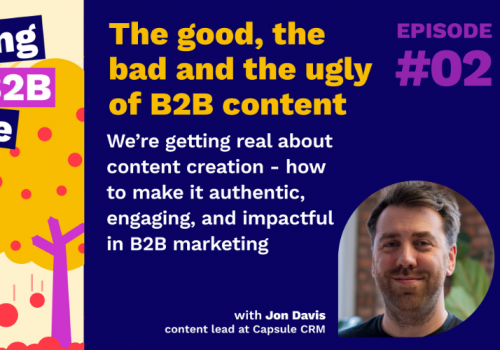
As part of our podcast, Shaking the B2B Tree, we spoke to Jon Davis at Capsule CRM about the good, the bad and the ugly of B2B content. His key takeaway supports this point, stating “it isn’t about ticking boxes – it’s about telling stories that matter. If it doesn’t resonate, inspire or add value, it’s just more noise”.
Working with an experienced thought leadership agency can bring an external perspective that helps identify blind spots in your current content strategy. They can quickly assess what makes your company’s approach unique and help articulate those differentiators in ways that resonate with your target buyers.
2. Distribute expertise across your organisation
As a marketing leader, you know that relying solely on your CEO for thought leadership creates bottlenecks and limits your content output. The most compelling B2B content comes from practitioners who solve specific customer challenges daily and these internal experts often have the insights your target audience most want to hear. Think about the following:
- Head of customer success: they will know which implementation strategies actually work and which sound good in the boardroom but fail in practice.
- Lead developer or CTO: they will understand the technical nuances that your competitors’ marketing materials gloss over.
- Sales director: they will have heard every procurement objection and know the real reasons deals stall.
For example, a cybersecurity firm’s CISO writing about ‘The hidden costs of security tool sprawl’ carries infinitely more weight with IT decision-makers than another generic piece about ‘cybersecurity best practices’ from the marketing team.
The flipside is that your internal experts are busy and often lack the time or writing skills to create publication-ready content. This is where specialised thought leadership agencies prove invaluable. They know how to extract insights from subject matter experts through structured interviews (at Skout, we call them foraging calls) and transform technical knowledge into compelling narratives that support your marketing objectives.
3. Work with AI, don’t fight it

AI systems are getting better at identifying expertise, authority, and trustworthiness. This creates opportunities for businesses willing to adapt their content strategy. Therefore you should take the following actions to ensure that your content is in the best position possible.
- Structure for AI discovery: use clear headings, include author bios with relevant credentials, and publish under consistent expert profiles. AI systems use these signals to attribute credibility and improve search visibility.
- Optimise for intelligent search: when B2B buyers use AI-powered research tools, these systems scan for depth and specificity. Surface-level content gets filtered out; expert insights get elevated.
What does this look like in practice? Instead of a broad post about “Digital transformation trends,” write “Why 73% of manufacturing digital transformation projects fail (and the three prerequisites we’ve identified for success)’. The second approach signals expertise and provides the specificity AI systems reward.
4. Build credibility through consistency
Publishing one insightful piece won’t establish thought leadership or move the needle on your lead generation or brand awareness goals. You need to demonstrate sustained expertise over time which requires both strategic planning and consistent execution. Statistics reveal that companies publishing expert-driven content twice monthly see 30% higher engagement rates and generate 25% more qualified inbound leads than those with sporadic publishing schedules.
To ensure cadence, consider using a content calendar. Map your experts’ knowledge areas to your ideal clients’ yearly challenges and budget cycles. If you serve CFOs, plan Q1 content around budget planning, Q2 around compliance updates, and so forth. Another way to ensure a consistent flow of content is through cross-format amplification. Turn one expert insight into multiple touchpoints that support your demand generation goals e.g. a detailed blog post, a LinkedIn article, a podcast discussion, and a webinar deep-dive.
This might sound simple, but we know that many marketing teams struggle to maintain consistency while managing campaigns, events and other priorities. Partnering with an agency can ensure regular publication schedules and free up you team for focus on campaign management and nurturing.
5. Use proprietary data as your secret weapon

Generic opinions are everywhere. Unique data is rare and valuable. Where appropriate, we always encourage our clients to tap into data as this is a proven way to bring fresh insights to customers, prospects, peers and even journalists. The good news is that data can be collected in many different ways. Consider accessing customer data insights (this can be done anonymously) to identify micro and macro trends; working with a research specialist to conduct industry benchmarking can be a good way to gain data around particular themes; or, you can lean on your process documentation to uncover patterns, efficiencies, and differentiators that can be translated into compelling thought leadership.
When you own the data, you own the conversation.
6. Connect thought leadership to your marketing objectives
Effective thought leadership does more than build awareness — it drives pipeline and revenue. Align your content with sales and marketing by addressing real buyer objections, identified through collaboration with your sales team. Use tailored insights to support ABM efforts; for instance, a personalised piece from your CTO can unlock high-value conversations. Establish credibility early to shorten sales cycles and consider partnering with a specialist agency to ensure your content supports every stage of the B2B buyer journey.
Also, don’t overlook the power of PR. Media coverage, podcast features, and bylined articles offer third-party validation that boosts brand authority and attracts inbound interest. When integrated across sales, marketing, and PR, thought leadership becomes a strategic growth engine
7. Measure impact, not just engagement
Clicks and likes are easy to track but they don’t tell you if your thought leadership is actually shifting perception. In B2B, the real value lies in influence. Focus on metrics that reflect authority and visibility: share of voice across media and search, branded keyword growth, and expert mentions in trusted third-party publications. Track how often your spokespeople are quoted, how frequently your brand appears in industry conversations, and whether you’re edging out competitors in key spaces. These indicators reveal whether your thought leadership is earning attention, shaping narratives, and reinforcing your position in the market; outcomes that justify investment and support long-term brand growth.
If you’re unsure where to start, download our Demystifying Measurement report.
Your next move
The B2B brands that lead their markets are those investing in expertise over promotion. To kickstart your strategy, identify three internal experts whose insights can differentiate your brand, and capture one contrarian view or proprietary approach from each that addresses buyer pain points. Then assess whether your team can consistently produce and amplify expert-led content that aligns with your marketing goals. If not, consider partnering with a specialised thought leadership agency to accelerate results, elevate editorial quality, and apply measurement that links directly to visibility and commercial impact.
At Skout, we help B2B brands turn internal expertise into market-leading thought leadership. From uncovering unique insights to amplifying them through your key marketing channels, our specialist team delivers measurable impact through editorial excellence, PR visibility, and strategic content planning. Ready to own the conversations that matter? Get in touch with us today.