

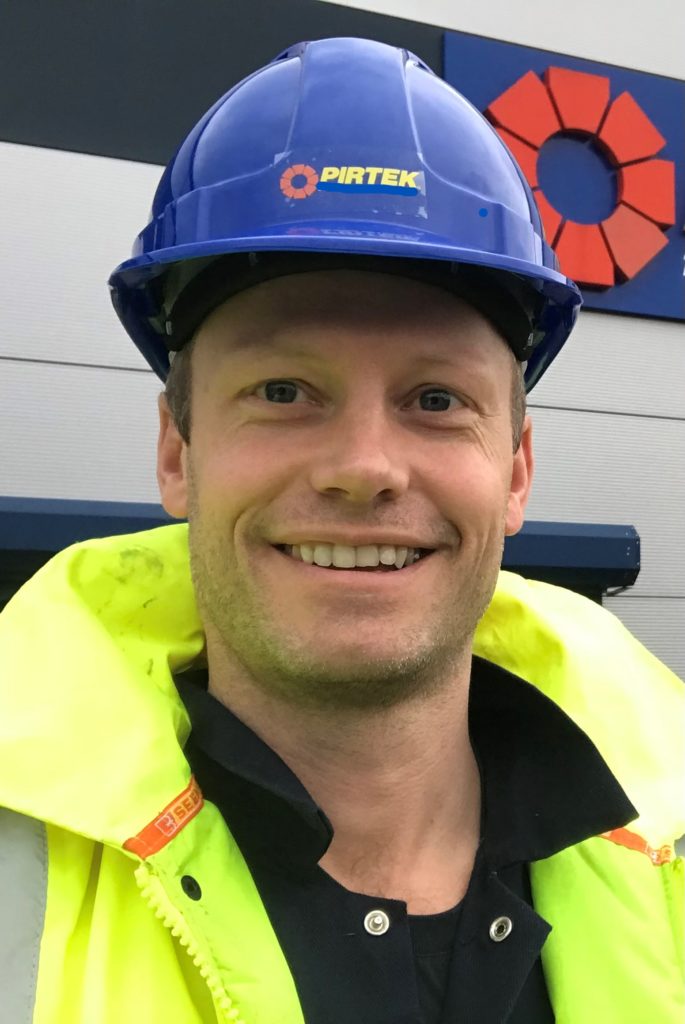
Chris Linsell left university with a degree in Economics and Finance but knew that this was not where his true interests lay. In 2004 he joined an independent creative advertising agency called Mustoes and has not looked back since.
Q: Tell me a little bit about your background before joining Pirtek as Marketing Director Chris.
A: As a graduate I joined Mustoes and got my first taste of the world of marketing and advertising. Many of our clients were challenger brands which required us to be bold and punch above our weight in terms of creativity and delivery. It was a really exciting place to learn the ropes and develop / fast track my career. In 2010 we merged with a PR agency and became Kindred. With the newly formed agency I was able to focus on advertising-led integrated campaigns. I gained a huge amount of knowledge and insight whilst working at Kindred, understanding the potential impact/return with different media and creative solutions. Then kids came along and it was time for a fresh challenge. I joined Wolff Olins on a fixed term contract as a programme director working with world class people and some big brands. Once that contract came to an end I applied for the role at Pirtek UK and Ireland.
Q: What do you believe are the major differences between running marketing in a franchise model compared to in a wholly owned business?
A: I’d say much of the answer to this question depends on the size of the wholly owned business, plus there’s been immense change around working practices and digital transformation recently. But essentially here are the main differences.
- Product: With a franchise you have the challenge of quality control and brand consistency. To be successful, a good education and learning programme is needed, with clear guidance for a number of audiences. The marketing department needs support from many internal departments in order to monitor and manage the brand reputation effectively.
- People: Trust and relationships are essential in a franchise model to enable an entire organisation to reach its potential. A franchise model offers the benefit of passionate owners throughout a territory. There is a natural foundation of supporting people (expertise/skills and people) in a franchise organisation that helps breed a positive culture.
- Promotion: For a franchise model there are a few more moving parts as we have our franchisee audience to support and empower ahead of any campaign. A great deal of work goes into setting up systems, processes and education to allow local marketing to flourish. When this is controlled as part of a wholly owned business there is almost no choice but to follow guidance from central marketing.
- Measurement and Reporting: Access to and ownership of data brings challenges in a franchise model. Investing time in developing these systems is a necessity in order to be able to understand and showcase the real impact of marketing.
- Insights: In a franchise organisation, especially one with a physical presence, there is a strong desire to share local knowledge which helps the marketing team create and deliver effective local campaigns
Q: What are some of the techniques you have employed to make marketing in a franchise environment successful?
A: Time management: Appreciate that stakeholder’s time is often limited so it is important to identify critical moments and make the most of them. Sometimes these moments are planned such as regular network calls or annual events, and other times they are unpredictable. Being available to help and support franchisees and their teams is of paramount importance. The power of a network of passionate, active people can never be underestimated, so we set aside time in our diaries on a weekly basis so we can be on hand to support our network with requests and queries.
Brilliant basics: Be clear on the essentials for the next phase of the journey. Whatever the topic, from whole scale digital transformation programmes to local marketing, make sure strong foundations are developed and that there is the time, space and expertise on-hand to deliver them brilliantly.
Assumption-based planning: Sometimes it is unrealistic to expect to gather information or insights from all franchisees when planning campaigns. In order to deliver a high volume of tactical local campaigns, or push ahead with national campaigns, some assumptions are always necessary.
Transparent reporting: Transparency is essential in building trust and a positive culture. Never underestimate the importance of regular knowledge sharing and clear, simple reporting.
Weekly compass check: There’s a fine or sometimes no line between work and life. Working in a high-growth business, with multiple stakeholders and a range of challenges and opportunities that are part of our every day, is not easy. Throw in new practices such as remote working on top and it is more important than ever to have a good connection with people in your team and offer clear direction. If a team is clear on priorities and has the space they need to perform, then you’re off to a good start.
Journey planner: it’s essential to have an idea of what the journey looks like when going into a role, and what short and long term wins look like. This plan is an incredibly important and useful reference point when talking to stakeholders. One of my first priorities was to build a team both internally and with external marketing partners to help deliver a cohesive strategy. Now we are building on the brand story and continuously improving platforms and campaigns to make marketing promotion highly effective. Internally, at the beginning of a week or month or year, talk to the team about what a good outcome is and keep it memorable and inspiring.
Q: What percentage of your job is PUK versus marketing for the franchisees?
A: I see them entirely aligned and make no real distinction between the two. What we do for PUK serves our franchisees so marketing for one benefits the other.